Morning Class by Gurudeva:
SB 10.31.9
tava kathāmṛtaṁ tapta-jīvanaṁ
kavibhir īḍitaṁ kalmaṣāpaham
śravaṇa-maṅgalaṁ śrīmad ātataṁ
bhuvi gṛṇanti ye bhūri-dā janāḥ
The nectar of Your words and the descriptions of Your activities are the life and soul of those suffering in this material world. These narrations, transmitted by learned sages, eradicate one’s sinful reactions and bestow good fortune upon whoever hears them. These narrations are broadcast all over the world and are filled with spiritual power. Certainly those who spread the message of Godhead are most munificent.
Purport
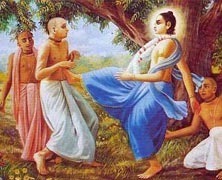
King Pratāparudra recited this verse to Śrī Caitanya Mahāprabhu during Lord Jagannātha’s Ratha-yātrā festival. While the Lord was resting in a garden, King Pratāparudra humbly entered and began massaging His legs and lotus feet. Then the King recited the Thirty-first Chapter of the Tenth Canto of the Śrīmad-Bhāgavatam, the songs of the gopīs. The Caitanya-caritāmṛta relates that when Lord Caitanya heard this verse, beginning tava kathāmṛtam, He immediately arose in ecstatic love and embraced King Pratāparudra. The incident is described in detail in the Caitanya-caritāmṛta (Madhya 14.4-18), and in his edition Śrīla Prabhupāda has given extensive commentary on it.
Nityananda Prabhu was born to a religious Bengali Brahmin, known as Pandit Hadai and Padmavati in Ekachakra (a small village in Birbhum district of present West Bengal) around the year 1474. His devotion and great talent for singing Vaishnava hymns (bhajan) were apparent from a very early age. In his youth, he would generally play the part of Lakshman, Rama's younger brother, in dramatic re-enactments of Lord Rama's pastimes, along with the other boys of Ekachakra.
At the age of thirteen, Nitai left home with a travelling renunciate (sannyasi) known as Lakshmipati Tirtha. Nitai's father, Hadai Pandit, had offered the travelling sannyasi anything he wished as a gift. To this Lakshmipati Tirtha replied that he was in need of someone to assist him in his travels to the holy places (he was about to begin a pilgrimage) and that Nitai would be perfect for the job. As he had given his word Hadai Pandit reluctantly agreed and Nitai joined him in his travels. This started Nitai's long physical and spiritual journey through India which would get him in contact with important Gurus of the Vaishnava tradition.
Anyone can be merciful by first becoming merciful upon yourself and embrace the process - sravanam, kirtanam and put yourself under the care of the physicians. When we go out to distribute books, we think about Nityananda Prabhu to get his mercy.
===============
Bhajana Kutir of Srila Bhakti Siddhanta Sarasvati Gosvami Maharaj, Tota Gopinath, Cataka Parvat
We sung this song from Bhaktivinod Thakur has written this song “Gopinath Mama Nivedana Suno”. The official name for this song is Gopinath (Part one). This song is taken from the book Kalyana Kalpataru (Section: Upalabdhi Vijnapti Song 1). Bhaktivinoda Thakura says that we are all sinners at the Lotus feet of Sri Krishna and due to this we have no good qualities in us. We are puppets and have no control over this body. We have no transcendental knowledge. Hence we should bow down at Govinda for His causeless mercy to deliver us from this sinful material land. He enacts different pastimes to help the fallen souls.
(1)
gopinath, mama nivedana suno
vishayi durjana, sada kama-rata,
kichu nahi mora guna
(2)
gopinath, amara bharasa tumi
tomara carane, loinu sarana,
tomara kinkora ami
(3)
gopinath, kemone sodhibe more
na jani bhakati, karme jada-mati,
porechi somsara-ghore
(4)
gopinath, sakali tomara maya
nahi mama bala, jnana sunirmala,
swadina nahe e kaya
(5)
gopinath, niyata carane sthana
mage e pamara, kandiya kandiya,
korohe karuna dana
(6)
gopinath, tumi to’ sakali paro
durjane tarite, tomara sakati,
ke ache papira aro
(7)
gopinath, tumi kripa-parabara
jivera karane, asiya prapance,
lila koile subistara
(8)
gopinath, ami ki doshe doshi
asura sakala, pailo carana,
vinoda thakilo bosi’
(1) 0 Gopinatha, Lord of the gopis, please hear my request. I am a wicked materialist, always addicted to worldly desires, and no good qualities do I possess.
(2) 0 Gopinatha, You are my only hope, and therefore I have taken shelter at Your lotus feet. I am now Your eternal servant.
(3) 0 Gopinatha, how will You purify me? I do not know what devotion is, and my materialistic mind is absorbed in fruitive work. I have fallen into this dark and perilous worldly existence.
(4) 0 Gopinatha, everything here is Your illusory energy. I have no strength or transcendental knowledge, and this body of mine is not independent and free from the control of material nature.
(5) 0 Gopinatha, this sinner, who is weeping and weeping, begs for an eternal place at Your divine feet. Please give him Your mercy.
(6) 0 Gopinatha, You are able to do anything, and therefore You have the power to deliver all sinners. Who is there that is more of a sinner than myself?
(7) 0 Gopinatha, You are the ocean of mercy. Having come into this phenomenal world, You expand Your divine pastimes for the sake of the fallen souls.
(8) 0 Gopinatha, I am so sinful that although all the demons attained Your lotus feet, Bhaktivinoda has remained in worldly existence.
Katha at Tota Gopinath by HG Madhavananda Prabhu
Nityananda prabhu used to sing:
bhaja gauranga kaha gauranga laha bhaja gaurangera nama re
jei jan bhaja gauranga bhaje, sei hoy amara prana re
gaurango boliya du bahu tuliya
nachiya nachiya berao re
gaurango bhajile gaurango jopile hoy
dukhyero aboshaan re
Refrain: Worship Lord Gauranga! Chant Gauranga! Speak about Lord Gauranga only! Those who worships and serves Lord Gauranga is indeed my life and soul.
One of the classrooms in the university and each classroom represents a lesson on how to approach Vrindavan. The importance of Kritajna is taught here at Tota Gopinatha. Gratitude is the fuel for our fire, it's like the firewood which fuels our bhajan.
How is this the place of Gratitude?
When the Gopis heard the sound of the flute, they became mad and they just wanted to run to Gopinath. They just took the spoon and threw it away, some were nursing the babies, in the middle of thenight they just left what they were doing and they just ran towards Gopinath. However anyone runs to Gopinath, Gopinath reciprocates with them the same way. When we come to these places, we might be approaching the dhaam, on the lips we might be singing Gopinath please be merciful to me but in our heart we might have lots of desires. So, Vaishnavas savadhan, the gopis when they ran to Gopinath, the song they had on their lips was the same heart they had in their heart, the gratitude they had for Krishna. Seeing the gopis how they left and came to Krsna, they only wanted to please Krsna and then Krsna said I'm stumped, how can I reciprocate with that? I can't give you anything. He said, your own behavior be your own glory.
What does that mean? It means its the beginning and the end. It all began from here at Tota Gopinath. When he blew the flute, the gopis running towards Him and the prema dhana the gopis have for Krsna. Krsna said, He can't repay the love for Krsna. Krsna decided I need to get a job and He dressed as a gopi called Ramika. He disguised him and He came to serve Radharani, but Radharani said go away. Then He begged to Radhrani that please give me some love. Krsna approached Radha and said Radha only you have this love which I can use to repay the debt of the Gopis. Radharani said, you ask Lalita as I'm a mad women. So even after begging He didn't get anything, so He had to steal. He's the greatest of all thief. Krsna entered into Srimati Radharani's heart to steal Her love from the heart. To know more about this, you can read from the Embankment of Separation book. He had to melt it, for that he had to apply heat and the heat was the Vibralamba of separation. He entered into her heart and suddenly when He came out, it became different - Krsna became molten gold, Vrindavan was gone, Gopis were gone, Yamuna river was gone and it became Mayapur/Navadwip lila and the Sankirtan movement. So it all started from here Tota Gopinath. Gopinath had the debt of love and He had to pay in the same currency, He had to experience the same thing what Radha and the Gopis had experienced, they left home and ran for Krsna, so Mahaprabhu had to leave His home - Saci etc. Even though their love was more, yet He had more higher love in His heart and Gopis wanted to see only one thing - Radha with Krsna. Krsna is Mahasakha, He wants to reciprocate with everyone in however they people recriprocates with each other. But Radharani's love was one pointed so to repay His debt He also needed to be one pointed and that means Gopi Bhav and this is where it all began. This is one of the best places in the world.
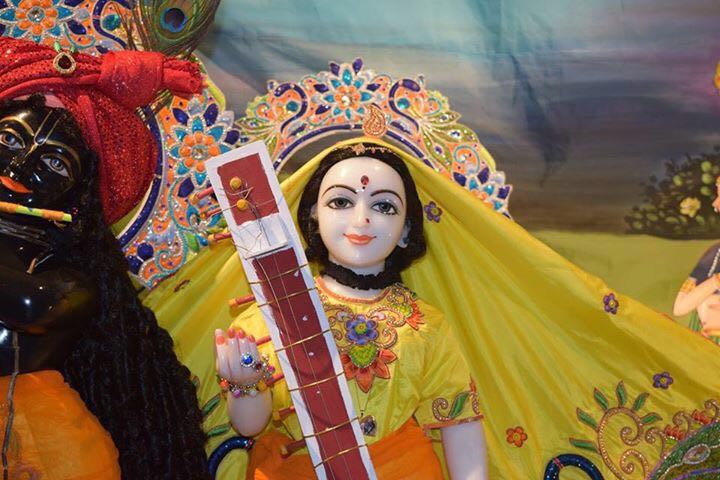
When Mahaprabhu came here, Gadadhara is Radharani and Mahaprabhu is also in the mood of Radha, so it became a little complicated. So one day He was sitting with Gadhadhara and Mahaprabhu was digging in the Chatak Parvat, He suddenly revealed under the Chatak Parvat, He found Tota Gopinath and asked Gadhadhara would you worship Tota Gopinath. Tota Gopinath is sitting down, Radharani is a different mudra and Lalita is in Krsna's flute mudra and they are all black. Some says Gopinath sat when Gadadhara pandit became old, but Gadhadhara was 45 so he wasn't old. Gadhadara aged very quickly after Mahaprabhu left, so it might be true.
Another story is about Mamu Thakur, he was disciple of Gadadhara Pandit and maternal uncle of Mahaprabhu. It was Mamu Thakur who installed the dieites of Balaram, Revati and when he became old he wasn't able to put the crown on Tota Gopinath and hence Tota GOpinath to help his devotee sat down to help him in his seva.
Another story was that He was always sitting down. It was the lord of the GOpis, after He danced with the Gopis he bathed in the Yamuna and the Gopis and they made a pile of sand for Krsna to sit down and that's why Gopinath is sitting down. He has a moon locket on his neck.
Why are Radharani and Lalita black, when Krsna left the Rasalila, the Gopis became mad in separation and in that separation thinking about Krsna their bodily complexsion became black. All the arts started from the Rasalila - singing, dancing, painting, cloth, drama - all these arts came from the Rasalila.
Mahaprabhu disappeared into the crack of Tota Gopinath and the small temple structure opposite Balrama and Revati is the pushpa samadhi of Mahaprabhu.
==========================
Evening Program
Sri Sri Shad-gosvamy-ashtaka
Eight Prayers to the Six Gosvamis
by Srinivasa Acarya
(1)
krishnotkirtana-gana-nartana-parau premamritambho-nidhi
dhiradhira-jana-priyau priya-karau nirmatsarau pujitau
sri-caitanya-kripa-bharau bhuvi bhuvo bharavahantarakau
vande rupa-sanatanau raghu-yugau sri-jiva-gopalakau
(2)
nana-sastra-vicaranaika-nipunau sad-dharma-samsthapakau
lokanam hita-karinau tri-bhuvane manyau saranyakarau
radha-krishna-padaravinda-bhajananandena mattalikau
vande rupa-sanatanau raghu-yugau sri-jiva-gopalakau
(3)
sri-gauranga-gunanuvarnana-vidhau sraddha-samriddhy-anvitau
papottapa-nikrintanau tanu-bhritam govinda-ganamritaih
anandambudhi-vardhanaika-nipunau kaivalya-nistarakau
vande rupa-sanatanau raghu-yugau sri-jiva-gopalakau
(4)
tyaktva turnam asesha-mandala-pati-srenim sada tuccha-vat
bhutva dina-ganesakau karunaya kaupina-kanthasritau
gopi-bhava-rasamritabdhi-lahari-kallola-magnau muhur
vande rupa-sanatanau raghu-yugau sri-jiva-gopalakau
(5)
kujat-kokila-hamsa-sarasa-ganakirne mayurakule
nana-ratna-nibaddha-mula-vitapa-sri-yukta-vrindavane
radha-krishnam ahar-nisam prabhajatau jivarthadau yau muda
vande rupa-sanatanau raghu-yugau sri-jiva-gopalakau
(6)
sankhya-purvaka-nama-gana-natibhih kalavasani-kritau
nidrahara-viharakadi-vijitau catyanta-dinau ca yau
radha-krishna-guna-smriter madhurimanandena sammohitau
vande rupa-sanatanau raghu-yugau sri-jiva-gopalakau
(7)
radha-kunda-tate kalinda-tanaya-tire ca vamsivate
premonmada-vasad asesha-dasaya grastau pramattau sada
gayantau ca kada harer guna-varam bhavabhibhutau muda
vande rupa-sanatanau raghu-yugau sri-jiva-gopalakau
(8)
he radhe vraja-devike ca lalite he nanda-suno kutah
sri-govardhana-kalpa-padapa-tale kalindi-vane kutah
ghoshantav iti sarvato vraja-pure khedair maha-vihvalau
vande rupa-sanatanau raghu-yugau sri-jiva-gopalakau
Translation:
(1) I offer my respectful obeisances unto the six Gosvamis, namely Sri Rupa Gosvami, Sri Sanatana Gosvami,
Sri Raghunatha Bhatta Gosvami, Sri Raghunatha dasa Gosvami, Sri Jiva Gosvami, and Sri Gopala Bhatta
Gosvami, who are always engaged in chanting the holy name of Krishna and dancing. They are just like the ocean
of love of God, and they are popular both with the gentle and with the ruffians, because they are not envious
of anyone. Whatever they do, they are all-pleasing to everyone, and they are fully blessed by Lord Caitanya.
Thus they are engaged in missionary activities meant to deliver all the conditioned souls in the material universe.
(2) I offer my respectful obeisances unto the six Gosvamis, namely Sri Rupa Gosvami, Sri Sanatana Gosvami,
Sri Raghunatha Bhatta Gosvami, Sri Raghunatha dasa Gosvami, Sri Jiva Gosvami, and Sri Gopala Bhatta
Gosvami, who are very expert in scrutinizingly studying all the revealed scriptures with the aim of
establishing eternal religious principles for the benefit of all human beings. Thus they are honored all over
the three worlds and they are worth taking shelter of because they are absorbed in the mood of the gopis and
are engaged in the transcendental loving service of Radha and Krishna.
(3) I offer my respectful obeisances unto the six Gosvamis, namely Sri Rupa Gosvami, Sri Sanatana Gosvami,
Sri Raghunatha Bhatta Gosvami, Sri Raghunatha dasa Gosvami, Sri Jiva Gosvami, and Sri Gopala Bhatta
Gosvami, who are very much enriched in understanding of Lord Caitanya and who are thus expert in
narrating His transcendental qualities. They can purify all conditioned souls from the reactions of their
sinful activities by pouring upon them transcendental songs about Govinda. As such, they are very expert
in increasing the limits of the ocean of transcendental bliss, and they are the saviors of the living entities from
the devouring mouth of liberation.
(4) I offer my respectful obeisances unto the six Gosvamis, namely Sri Rupa Gosvami, Sri Sanatana Gosvami,
Sri Raghunatha Bhatta Gosvami, Sri Raghunatha dasa Gosvami, Sri Jiva Gosvami, and Sri Gopala Bhatta
Gosvami, who kicked off all association of aristocracy as insignificant. In order to deliver the poor
conditioned souls, they accepted loincloths, treating themselves as mendicants, but they are always merged in
the ecstatic ocean of the gopis’ love for Krishna and bathe always and repeatedly in the waves of that ocean.
(5) I offer my respectful obeisances unto the six Gosvamis, namely Sri Rupa Gosvami, Sri Sanatana Gosvami,
Sri Raghunatha Bhatta Gosvami, Sri Raghunatha dasa Gosvami, Sri Jiva Gosvami, and Sri Gopala Bhatta
Gosvami, who were always engaged in worshiping Radha-Krishna in the transcendental land of Vrindavana
where there are beautiful trees full of fruits and flowers which have under their roots all valuable jewels.
The Gosvamis are perfectly competent to bestow upon the living entities the greatest boon of the goal of life.
(6) I offer my respectful obeisances unto the six Gosvamis, namely Sri Rupa Gosvami, Sri Sanatana Gosvami,
Sri Raghunatha Bhatta Gosvami, Sri Raghunatha dasa Gosvami, Sri Jiva Gosvami, and Sri Gopala Bhatta
Gosvami, who were engaged in chanting the holy names of the Lord and bowing down in a
scheduled measurement. In this way they utilized their valuable lives and in executing these devotional
activities they conquered over eating and sleeping and were always meek and humble enchanted by
remembering the transcendental qualities of the Lord.
(7) I offer my respectful obeisances unto the six Gosvamis, namely Sri Rupa Gosvami, Sri Sanatana Gosvami,
Sri Raghunatha Bhatta Gosvami, Sri Raghunatha dasa Gosvami, Sri Jiva Gosvami, and Sri Gopala Bhatta
Gosvami, who were sometimes on the bank of the Radha-kunda lake or the shores of the Yamuna and
sometimes at Vamsivata. There they appeared just like madmen in the full ecstasy of love for Krishna,
exhibiting different transcendental symptoms in their bodies, and they were merged in the ecstasy of
Krishna consciousness.
(8) I offer my respectful obeisances unto the six Gosvamis, namely Sri Rupa Gosvami, Sri Sanatana Gosvami,
Sri Raghunatha Bhatta Gosvami, Sri Raghunatha dasa Gosvami, Sri Jiva Gosvami, and Sri Gopala Bhatta
Gosvami, who were chanting very loudly everywhere in Vrindavana, shouting, "Queen of Vrindavana, Radharani!
O Lalita! O son of Nanda Maharaja! Where are you all now? Are you just on the hill of Govardhana, or are
you under the trees on the bank of the Yamuna? Where are you?" These were their moods in executing
Krishna consciousness.
Previously all the great sages and liberated all the people and hence we follow in their footsteps and whoever follow in their footsteps get the same results. Devotional service is defined by the Gosvamis as Anusilanam - follow and cultivate. In Nod, the cultivation takes place internally and externally. Externally, we follow in in the same activities they did - reading, writing books, preaching and kirtan. We can follow them in the ways they followed devotional service. That will help us to cultivate our internal devotional practice also.
Mahaprabhu fed all his devotees at the Jagannatha Vallabha Gardens and Mahaprabhu put enough prasadam in every plate and devotees all ate prasadam upto the neck and it was Mahaprabhu's program was to chant and dance together and then take prasadam. After devotees took prasadam he would give out prasadam to all people and ask them to say Haribol! Mahaprabhu and his followers would swim at Narendra Sarovar and Indradyumna Sarovar. They would splash each other and pair off and lot of water would be splashed. Swaroop Damodar and Sarvabhauma would also be playing and they would play like little kids. Sarvabhauma was such a scholor and still he was playing in the water and that is Bhakti, Devotional practice. While they were splashing they had open hearted fun and then Mahaprabhu said to Govinda, tell them how they are playing when they are big scholars and Mahaprabhu was actually joking. The devotees hence have a realm of joyfullness and in devotional practice is kevala ananda kanda.
Then Gurudeva sang the Dasavatara Strotram and explained each incarnation.
SB 12.13.2:
Translation
When the Supreme Personality of Godhead appeared as Lord Kūrma, a tortoise, His back was scratched by the sharp-edged stones lying on massive, whirling Mount Mandara, and this scratching made the Lord sleepy. May you all be protected by the winds caused by the Lord’s breathing in this sleepy condition. Ever since that time, even up to the present day, the ocean tides have imitated the Lord’s inhalation and exhalation by piously coming in and going out.
Purport
At times we alleviate an itching sensation by blowing upon it. Similarly, Śrīla Bhaktisiddhānta Sarasvatī Ṭhākura explains, the breathing of the Supreme Personality of Godhead can alleviate the itching sensation within the minds of mental speculators, as well as the itching of the material senses of conditioned souls engaged in sense gratification. Thus by meditating on the windy breath of Lord Kūrma — the tortoise incarnation — all categories of conditioned souls can be relieved of the deficiencies of material existence and come to the liberated, spiritual platform. One must simply allow the pastimes of Lord Kūrma to blow within one’s heart like a favorable breeze; then one will surely find spiritual peace.
Then Gurudeva sang Doyal Nitai Chaitanya.
Read from SB 3.6.36
Translation
In spite of my inability, whatever I have been able to hear [from the spiritual master] and whatever I could assimilate I am now describing in glorification of the Lord by pure speech, for otherwise my power of speaking would remain unchaste.
Purport
The purification of the conditioned soul necessitates purification of his consciousness. By the presence of consciousness, the presence of the transcendental soul is verified, and as soon as consciousness leaves the body, the material body is not active. Consciousness is perceived, therefore, by activities. The theory put forward by empiric philosophers that consciousness can remain in an inactive state is the proof of their poor fund of knowledge. One should not become unchaste by stopping the activities of pure consciousness. If the activities of pure consciousness are stopped, certainly the conscious living force will be otherwise engaged because unless engaged the consciousness has no standing. Consciousness cannot be silent, even for a moment. When the body does not act, the consciousness acts in the form of dreams. Unconsciousness is artificial; by induced extraneous help it remains for a limited period, but when the intoxication of the drug is finished or when one is awake, the consciousness again acts earnestly.
Maitreya’s statement is that in order to avoid unchaste conscious activities, he was trying to describe the unlimited glories of the Lord, although he did not have the ability to describe them perfectly. This glorification of the Lord is not a product of research, but the result of hearing submissively from the authority of the spiritual master. It is also not possible to repeat all that one has heard from his spiritual master, but one can narrate as far as possible by one’s honest endeavor. It does not matter whether the Lord’s glories are fully explained or not. One must attempt to engage one’s bodily, mental and verbal activities in the transcendental glorification of the Lord; otherwise such activities will remain unchaste and impure. The existence of the conditioned soul can be purified only by the method of engaging mind and speech in the service of the Lord. The tridaṇḍi-sannyāsī of the Vaiṣṇava school accepts three rods, representing the vow to engage in the service of the Lord with body, mind and speech, whereas the ekadaṇḍi-sannyāsī takes the vow to become one with the Supreme. Since the Lord is the Absolute, there is no distinction between Him and His glories. The glories of the Lord as chanted by the Vaiṣṇava sannyāsī are as substantial as the Lord Himself, and thus while glorifying the Lord the devotee becomes one with Him in transcendental interest, although he remains eternally a transcendental servitor. This simultaneously one and different position of the devotee makes him eternally purified, and thus his life becomes a complete success.
Videos:
Pictures: